The School to Prison Pipeline
Scroll for moreChildren of color are presumed guilty and dangerous by teachers, school officials, and police officers.
Children of color are presumed guilty and dangerous by teachers, school officials, and school resource officers, who utilize harsh disciplinary and broad criminalization practices that funnel minority students from school into the prison system. These practices disproportionately affect African American students, who are more likely to be suspended, expelled, and arrested than their white peers. Such treatment by school officials and law enforcement stigmatizes kids at school and shadows them for years, putting them at increased risk of ongoing involvement with the criminal justice system.
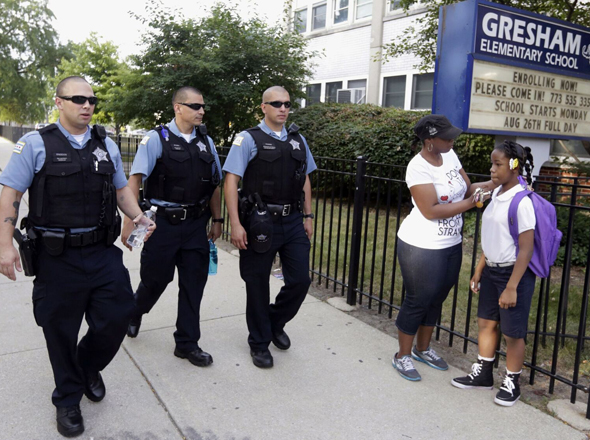
Photo: AP Photos/M. Spencer Green
The racially discriminatory treatment of students of color is a legacy of our history of racial injustice. Due to racial bias, teachers, school officials, and resource officers presume that African American children are dangerous and guilty. As a result, studies continue to show that the response to African American students’ minor infractions at school is disproportionate compared to their white peers.
Criminalizing minor infractions drives this disproportionate treatment of African American students. More than 20 states have laws that criminalize “disturbing school.” Under these laws, students have been arrested, charged, and convicted for minor infractions such as burping during an assembly, cursing, causing a scene in the library, and getting frustrated and pushing past a teacher.
Studies have shown that when teachers and school officials are given the discretion to determine students’ punishment, African American students are more likely to be suspended or expelled than white students. Increased police presence at school exacerbates the problem; 43 percent of public schools now have security personnel present at least once a week. When compared to African American students in schools without officers present, Black students in schools with officers are 3.49 times more likely to be arrested at school than white students.
This racially biased treatment of students of color at school by teachers, school officials, and officers can have a significant impact on a Black student’s life trajectory. Students who are suspended or expelled from school not only miss critical days of instruction, but are permanently stigmatized as “problem students,” which is strongly linked with subsequent involvement in the juvenile and criminal justice systems.
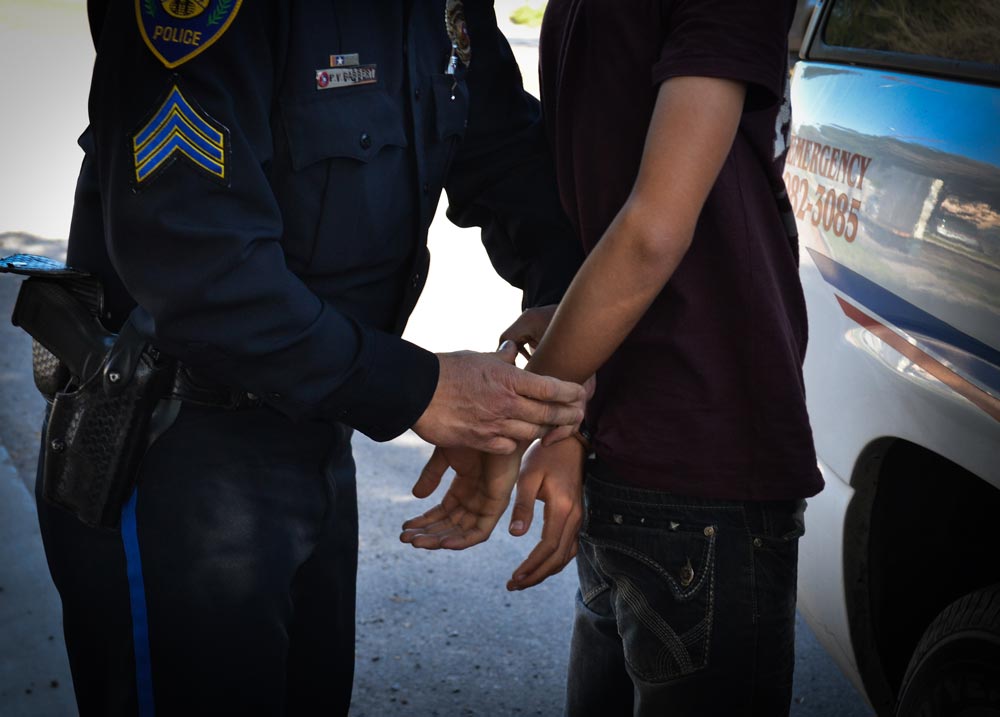
A high school student is handcuffed in Brownsville, Texas, for missing classes in 2013.
Photo: AP