Police Violence
Scroll for morePolice violence is rooted in law enforcement’s relationship to America’s history of racial violence.
In 2015, police killed an average of two unarmed Black people each week. This number, and the broader phenomenon of contemporary police brutality, cannot be confronted without understanding law enforcement’s relationship to America’s history of racial violence.
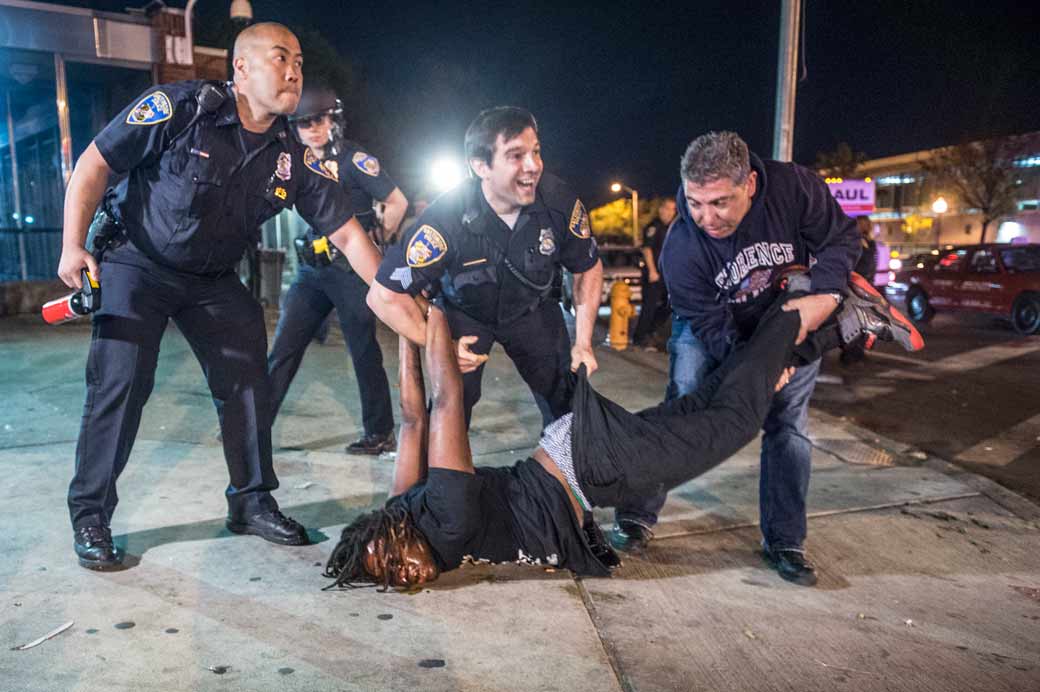
Photo: Joe Raedle/Getty Images Robert Stolarik/Polaris
Throughout the late 19th and early 20th centuries, law enforcement actively collaborated with white mobs to perpetrate racial terror lynchings. After World War II, racial terror lynchings declined, but unpunished white violence took new forms. Police violence became a potent tool to reinforce the racial caste system. In 1945, when Officer George Booker went on trial for clubbing to death Mrs. Niecey Brown, a 70-year-old African American woman, in Selma, Alabama, his lawyer cautioned the all white-jury, “If we convict this brave man who is upholding the banner of white supremacy, then we may as well give all our guns to the niggers and let them run the Black Belt.” The officer was acquitted after only minutes of deliberation.
Unpunished, racialized police violence was so rampant that the Civil Rights Congress filed a petition with the United Nations in 1951 detailing 152 killings and 344 acts of violence suffered by African Americans within the previous six years. Titled “We Charge Genocide,” the petition called international attention to the plight of Black people by shining a light on police brutality.
During the Civil Rights Movement, peaceful marches and sit-ins were often met with the policeman’s bullet, baton, and biting dog. Black activists who challenged the racial caste system were branded as criminals, and countless unarmed Black people were shot to death by the police. Fed up with police harassment, abuse, and killings, African Americans responded with uprisings and unrest in several major cities, including the neighborhood of Watts in Los Angeles in 1965. In 1991, more than a quarter of a century later, a federal court concluded that Los Angeles sheriff’s deputies still used racially motivated “terrorist-type tactics” to violate the rights of African Americans.
Police brutality continues to terrorize African American communities, and the widespread civilian use of cell phone video cameras and growing existence of body and dashboard-mounted cameras have created national awareness of the realities of policing in many communities of color. In 17 of the 100 largest American cities, police departments kill Black men at a rate that exceeds the national murder rate. A 2017 study revealed that “Black people were more likely to be killed by police, more likely to be unarmed and less likely to be threatening someone when killed.” In October and November 2017 alone, 33 African Americans were killed by law enforcement. Less than 1 percent+ of police officers are ever indicted for fatally shooting civilians. Even fewer are convicted.
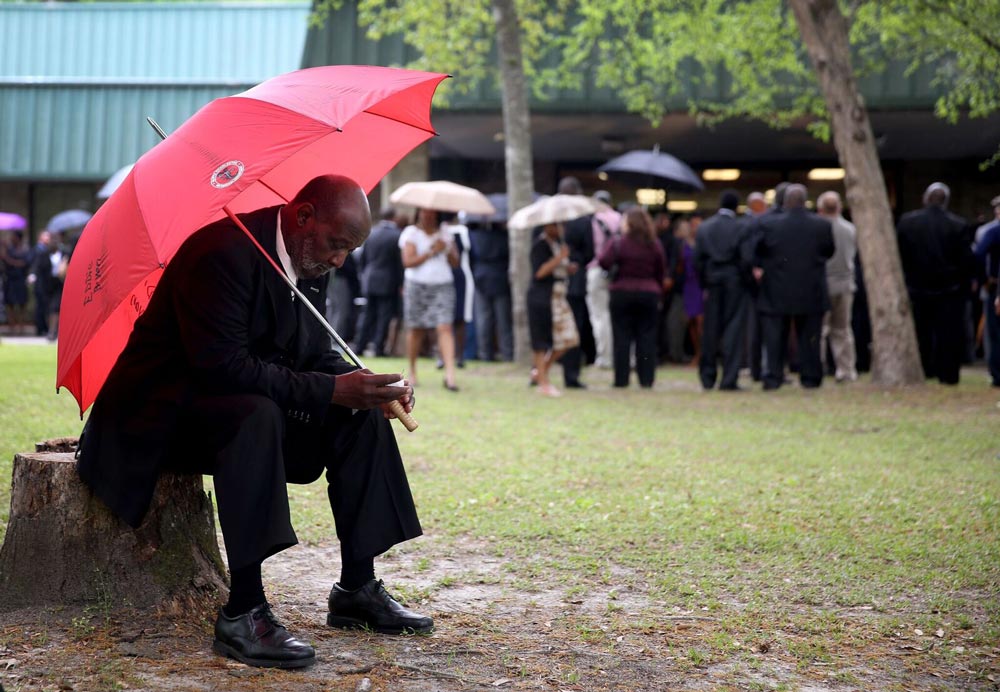
Funeral for Walter Scott after he was murdered in 2015 by a white police officer following a routine traffic stop in Charleston, South Carolina.
Photo: Getty Images/Joe Raedle