Criminalizing Drug Use and Substance Dependency
Scroll for moreAfrican Americans are disproportionately arrested, convicted, and sentenced for drug offenses.
After President Richard Nixon declared a “war on drugs” in 1971, the number of people incarcerated in American jails and prisons increased more than seven-fold. John Ehrlichman, Nixon’s domestic policy chief, later explained the rationale behind the war on drugs:
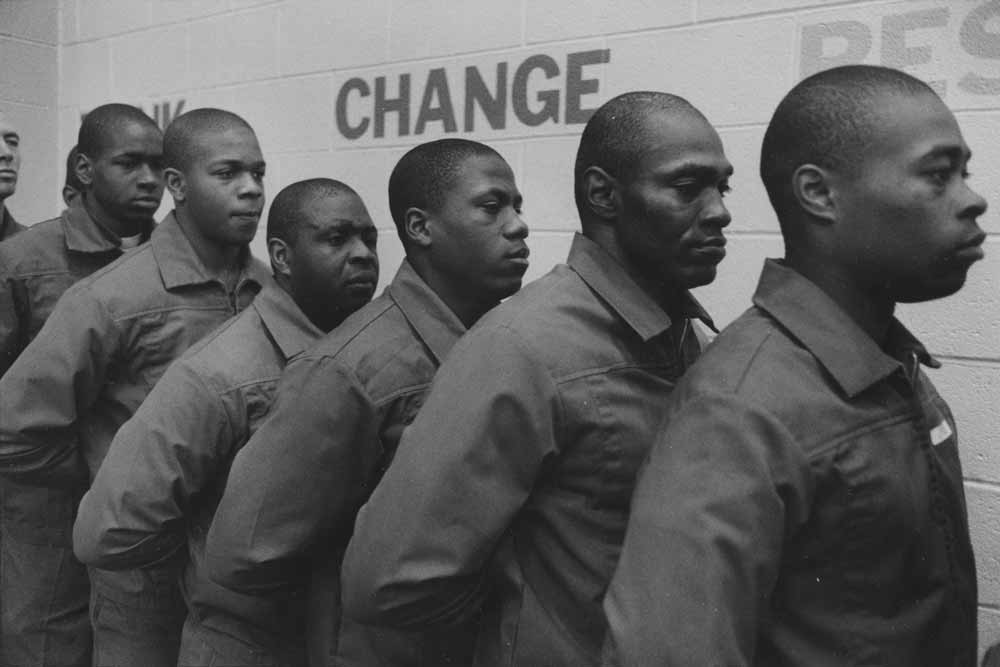
Men convicted of drug crimes undergo a military style boot camp at Lakeview Shock Camp in New York.
Photo: Andrew Lichtenstein/Corbis via Getty Images
“We knew we couldn’t make it illegal to be either against the [Vietnam] war or Black, but by getting the public to associate the hippies with marijuana and Blacks with heroin, and then criminalizing both heavily, we could disrupt those communities. We could arrest their leaders, raid their homes, break up their meetings, and vilify them night after night on the evening news. Did we know we were lying about the drugs? Of course we did.”
Although African Americans and white people use drugs at the same rate, and even though white people are more likely to sell drugs, African Americans are disproportionately arrested, convicted, and sentenced for drug offenses. Black men and women make up 12.5 percent of drug users but comprise 29 percent of those arrested for drug crimes, 46 percent of those convicted for drug crimes, and 33 percent of those sentenced to prison for drug crimes. African Americans now serve almost as much time in federal prison for a drug offense as white people do for a violent offense.
The war on drugs has devastated communities of color, locking up fathers and increasingly mothers as well. African American children are six times more likely to have a parent incarcerated than white children. Today, one out of nine African American children has a parent in jail or prison.
Federal and state governments continue to incarcerate people for their addictions, even though research shows that alternatives to incarceration achieve better outcomes at a reduced cost. Recognizing that addiction is a disease, some countries like Portugal treat drug use as a public health issue. After Portugal decriminalized drugs in 2001, the country experienced dramatic drops in risky drug use, overdose deaths, HIV and hepatitis infection rates, and its rate of incarceration.

In 1981, Congress passed the Military Cooperation with Law Enforcement Act, giving police access to military weapons in the “War on Drugs.”
Photo: Getty Images/dstephens