The Death Penalty
Scroll for moreThe death penalty is a direct descendant of lynching.
In the 1940s, court-ordered executions became America’s “solution” to the bad optics of lynching. Lynching was moved indoors, insulated from bad press, and institutionalized with a facade of due process. In determining who lived or died, clear racial patterns were evident. Today, the states that had the highest rates of lynching execute the most people – a disproportionate number of whom are African American.
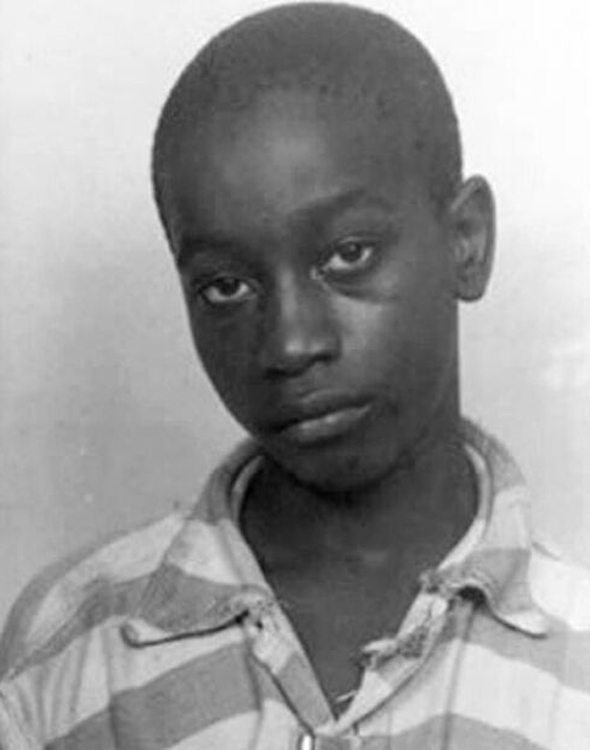
Photo: AP
As lynching declined in the 1940s, court-ordered executions of African Americans increased. In 1931, nine Black teenagers were arrested after being falsely accused of raping two white women on a freight train. After nearly being lynched, they were brought to trial in Scottsboro, Alabama, where they were represented by a drunk lawyer. Although the teens were innocent, all-white juries delivered guilty verdicts and eight of the boys were sentenced to death. The teenagers’ lives were saved after a series of appeals, but countless other Black children and adults faced similar sham trials and were ultimately executed.
In 1944, George Stinney, age 14, was arrested in Clarendon County, South Carolina. After a two-and-a-half-hour trial, an all-white jury deliberated for 10 minutes and convicted him of raping and murdering two white girls. Eighty-one days later, the 95-pound boy was strapped into the electric chair. Too small for his head to reach the electrodes, the white prison guards used a Bible as a booster seat. Seventy years after he was executed, a South Carolina judge vacated George Stinney’s conviction and he was posthumously exonerated.
In the 1972 case, Furman v. Georgia, the Supreme Court ruled that the death penalty was unconstitutional because of its arbitrary and discriminatory application. In response, 35 states passed new death penalty laws, which the Court upheld in 1976. These new laws claimed to minimize racial discrimination in capital sentencing, but the death penalty continues to be defined by bias and error.
The most comprehensive study of race’s influence on capital sentencing revealed that the death penalty is 22 times more likely to be imposed when the defendant is Black and the victim is white. When confronted with these statistics in the case McCleskey v. Kemp (1987), the Supreme Court accepted the study’s findings as valid, but declined to act, declaring that racial bias in the death penalty is “inevitable.” McCleskey remains the law today.
The failure to address racial discrimination has contributed to an extraordinarily high error rate. For every nine people executed in the United States since 1976, one person on death row has been exonerated. Innocent Black people are approximately seven times more likely to be falsely convicted of murder than innocent white people.
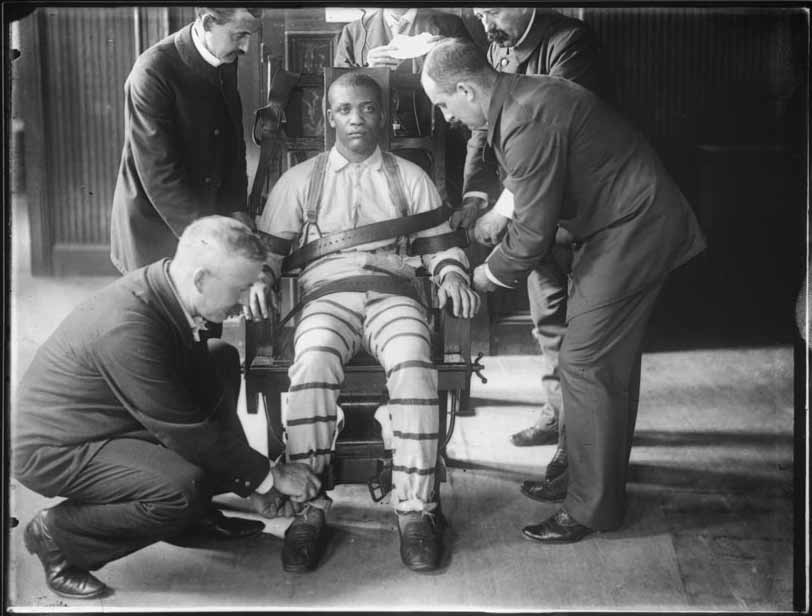
A man is strapped into the electric chair at Sing Sing Correctional Facility in New York, where a total of 614 people were executed.
Photo: William M. Van der Weyde/Eastman Museum